
You know that feeling when you’re doing something out of sheer stubbornness, not because it actually makes sense anymore? That’s where a lot of small landlords end up with self-management. You started with one property, maybe two. It felt doable. Empowering, even. You saved money. You learned the ropes. You handled things.
But then something shifts.
Maybe it’s the third tenant who texts you at 10 p.m. about a “water issue” that turns out to be a dripping faucet. Maybe it’s the morning you realize you’ve spent more time dealing with rental drama than actually working your day job. Or maybe it’s just the slow, creeping sense that this isn’t fun anymore. That you’re not saving money so much as paying yourself poverty wages for work you’re not even good at.
Here’s the thing nobody tells you upfront: self-managing works beautifully until it doesn’t. And when it stops working, it doesn’t announce itself with a bang. It sneaks up on you. One leaked toilet at a time.
The Tipping Point Isn’t About Number of Units
Most people assume the breaking point is tied to portfolio size. Get to five units, hire help. Ten units, definitely bring in property managers. But that’s not how it works in real life.
I’ve seen landlords with two properties who are drowning, and others with six who seem weirdly unbothered. The difference isn’t the number of doors. It’s everything else.
It’s whether your tenants pay on time or need chasing every month. It’s whether your properties are newer builds or held together with duct tape and prayer. It’s whether you live five minutes away or two states over. And honestly? It’s whether you’re the kind of person who can set boundaries or the kind who answers every call, every time, because you’re worried about being a “bad landlord.”
Self-management works when your life has a margin. When you can absorb the interruptions. When dealing with a broken dishwasher doesn’t derail your whole Tuesday. But when that margin disappears, when your regular life is already at capacity, that’s when the math starts looking different.
According to The Earnest Homes, many landlords hit their limit not when they acquire more properties, but when their personal bandwidth shrinks. A new baby. A demanding job. A health issue. Suddenly, what felt manageable at three units feels impossible at the same three units.
The Real Costs You’re Not Counting
Let’s talk about what self-management actually costs, because most landlords only count the money they’re not paying property managers. That’s like celebrating the fact that you didn’t hire a mechanic while ignoring the 12 hours you spent trying to fix your car with YouTube tutorials.
Your time has value. Even if you’re not billing yourself hourly, you’re spending time you could use elsewhere. Time with family. Time building your actual career. Time doing literally anything that isn’t fielding texts about whose parking spot is whose.
Then there’s the opportunity cost. How many good tenants have you lost because you were slow to respond? How much rental income have you missed because you didn’t have systems in place to turn units quickly? How many maintenance issues became expensive repairs because you didn’t catch them early?
And let’s not pretend you’re doing it all correctly. Unless you’ve studied fair housing law, you’re probably making mistakes. Small ones, maybe. The kind that haven’t bitten you yet. But they’re there, waiting.
According to WeLease, one of the biggest hidden costs of self-management is the accumulated stress and decision fatigue that affects landlords’ ability to make strategic choices about their properties. You can’t think clearly about whether to sell, refinance, or expand when you’re mentally underwater dealing with day-to-day tenant issues.
The Signs You’re Past the Tipping Point
You might already be there. Most people are before they admit it.
You dread your phone ringing because it’s probably a tenant. You put off maintenance requests hoping they’ll somehow resolve themselves (they won’t). You’ve started resenting your properties instead of seeing them as investments. You’re making decisions based on what’s easiest in the moment, not what’s smartest long-term.
Here’s a test: if someone offered you an extra $300 a month to do nothing, would you take it? Of course. That’s essentially what property managers offer. Yes, they charge a fee. But if that fee buys you back your evenings, your weekends, your peace of mind? If it means professional tenant screening, proper documentation, someone else dealing with the 2 a.m. emergency calls?
The math might be better than you think.
What Happens When You Let Go
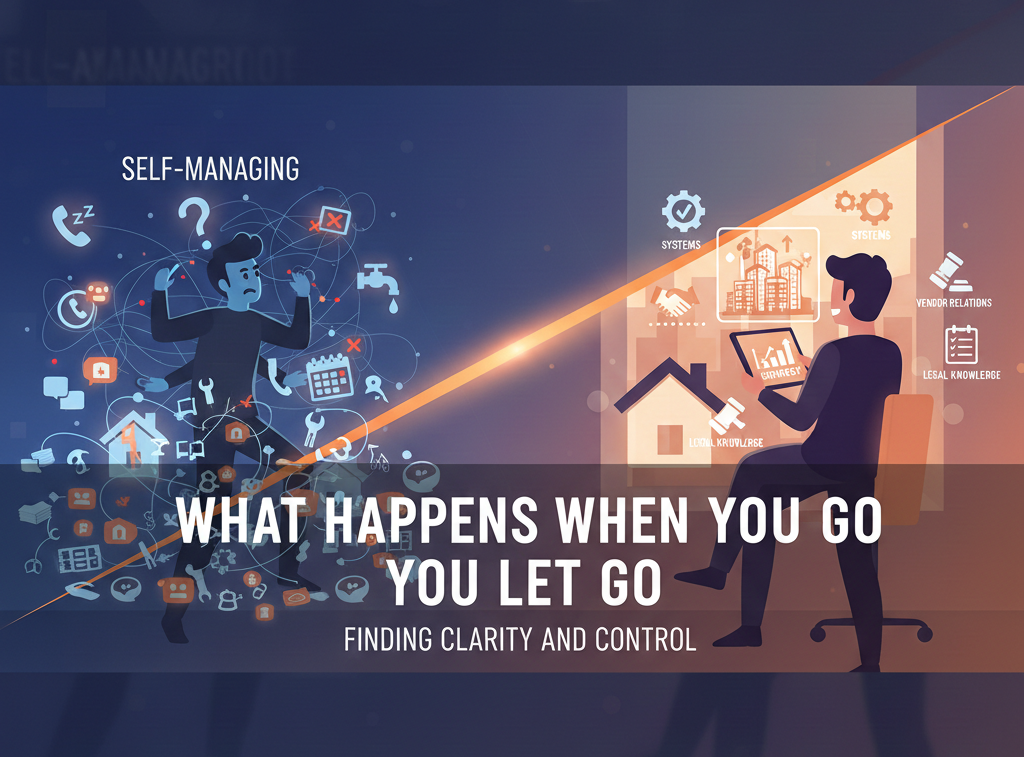
The weird thing about handing over management is how quickly you realize what you were missing. Not just time, though there’s that. But perspective.
When you’re in the weeds, you can’t see the forest. You’re too busy dealing with immediate problems to think strategically. Should you raise rents to market rate? Upgrade units to attract better tenants? Sell one property to buy two others in a better area? These questions require mental space you don’t have when you’re still trying to coordinate the HVAC repair.
Good property managers don’t just collect rent and handle maintenance. They bring systems. Vendor relationships. Legal knowledge. They’ve seen every weird tenant situation and know how to handle it. They’re not emotionally invested, which sometimes makes them better at the job than you are.
Does this mean every landlord should hire out? No. If you’ve got one easy property, great tenants, and you genuinely enjoy the hands-on aspect, keep at it. But if you’re reading this and nodding along, recognizing yourself in these scenarios? You might be past your tipping point and not admitting it yet.
The Bottom Line
Self-managing rental properties is a viable strategy until it isn’t. The shift happens differently for everyone, but it happens. Maybe you’re there now. Maybe you’re headed there. Maybe you’ve been there for a while and just needed someone to say it out loud.
There’s no shame in recognizing that doing everything yourself isn’t always the smartest move. Sometimes the most profitable decision is admitting you’d rather pay someone else to handle the parts of landlording that make you miserable.
Because at the end of the day, your properties should be building your wealth and your future, not consuming your present. If they’re doing the latter, something needs to change. It might not be adding more properties. It might not be selling. It might just be finally, finally, getting some help.